


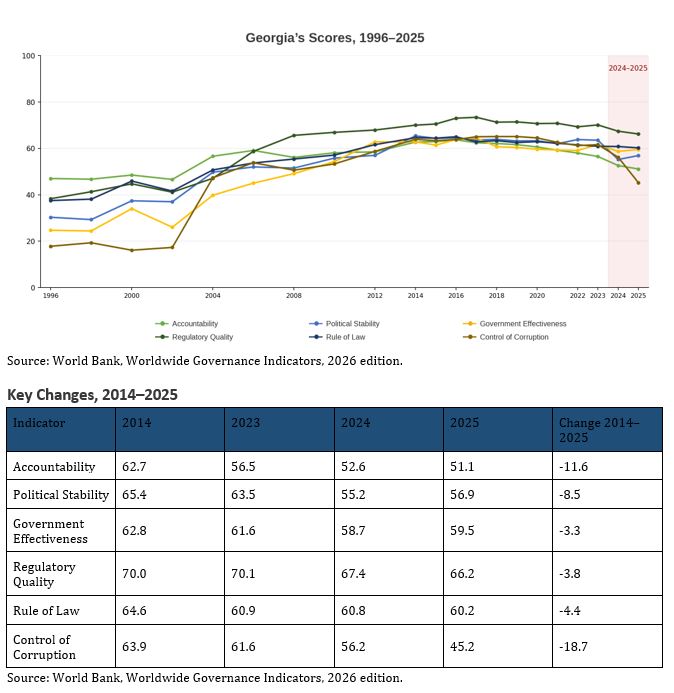
- The World Bank’s 2026 data show that in 2025 all six of Georgia’s governance indicators stood below their 2014 levels. This is no longer merely a slowdown in the pace of reform — the country is losing institutional positions achieved in previous years.
-The most substantial backsliding is recorded in Control of Corruption: between 2014 and 2025, the score fell by 18.7 points to 45.2. The decline in 2024–2025 alone amounted to 11.0 points.
- Accountability fell from 62.7 points in 2014 to 51.1 in 2025. The deterioration accelerated especially from 2024: the score dropped from 56.5 in 2023 to 52.6 in 2024 and to 51.1 in 2025. This directly coincides with a period of sharp restrictions on civic space, media freedom, political participation, and freedom of assembly.
- The year 2024 marks a turning point across several dimensions: Political Stability fell from 63.5 to 55.2; Government Effectiveness from 61.6 to 58.7; Regulatory Quality from 70.1 to 67.4; and Control of Corruption from 61.6 to 56.2. In 2025, some indicators recovered slightly, but the decline in the core indicators of democratic control continued.
- Relatively high scores in Regulatory Quality and Government Effectiveness do not offset the deterioration in democratic governance. On the contrary, the data reveal a growing imbalance: the state retains part of its administrative capacity, while checks on power, accountability mechanisms, and corruption-control safeguards are weakening.
- If IDFI’s 2021 analysis pointed to a significant slowdown in the pace of state development after 2014, the 2026 data show that this stagnation has now turned into systemic backsliding. The 2024–2025 dynamics confirm that the deterioration of the democratic environment is not a one-off fluctuation, but an entrenched trend.
The Worldwide Governance Indicators are a World Bank research database that brings together assessments by citizens, the private sector, and experts and evaluates the quality of governance across six dimensions. The 2026 database covers more than 200 countries and territories and publishes data for 1996–2025.
For many years, IDFI has systematically monitored Georgia’s position in the Worldwide Governance Indicators and analysed long-term trends in the quality of governance. The organisation’s previous studies consistently showed that, after the substantial progress achieved up to 2014, Georgia’s state-development trajectory weakened and the country failed to maintain previously attained high scores in several key areas. This trend was particularly clear in IDFI’s 2021 analysis, which already documented a slowdown in progress and deterioration across governance indicators.
The 2026 data, however, make the democratic backsliding even clearer. The problem is no longer only a slowdown in progress. The long-term trajectory across all six dimensions shows that Georgia has gradually been losing positions achieved after 2014, while deterioration in several critical areas has accelerated sharply since 2024. The dynamics are especially severe in Accountability and Control of Corruption — precisely the dimensions connected to public oversight of power, media and civic freedoms, constraints on high-level corruption, and institutional accountability.
These data are not an isolated statistical picture. The European Commission’s 2025 Georgia Report describes democratic backsliding, erosion of the rule of law, shrinking civic space, and problems with fundamental rights. Freedom House’s 2026 assessment also reduced Georgia’s overall freedom score to 51/100. The World Bank’s long-term indicators add a quantitative dimension to these assessments and show that the problems have intensified particularly since 2024.
Accountability — citizens’ participation in governance, freedom of speech and the media, freedom of assembly and association, and opportunities for public oversight of government.
Political Stability — perceptions of the risks of violent changes of government, political violence, and terrorism.
Government Effectiveness — the quality of public services, the professionalism and independence of the civil service, and the quality of policy formulation and implementation.
Regulatory Quality — the state’s ability to formulate and implement policies and regulations that support the functioning and development of the private sector.
Rule of Law — the effectiveness of the legal framework, the functioning of courts and law-enforcement institutions, protection of property rights, and the quality of law enforcement.
Control of Corruption — both petty and high-level corruption, the use of public power for private interests, and risks of state capture by elite or private interests.
The nearly three-decade trajectory of the Worldwide Governance Indicators reveals two sharply different phases in the development of governance quality in Georgia. From the 2000s, the country made rapid progress across a number of areas and accumulated significant gains in the first half of the 2010s. After 2014, however, the pace of improvement stalled, and in subsequent years the erosion of previously achieved progress began across several indicators.
This long-term backsliding has become particularly visible in recent years. In 2024–2025, deterioration was already clearly reflected across several key dimensions of governance, above all Accountability and Control of Corruption. The latest data therefore show not only that previous progress has stopped, but that Georgia is losing institutional gains accumulated over earlier decades.
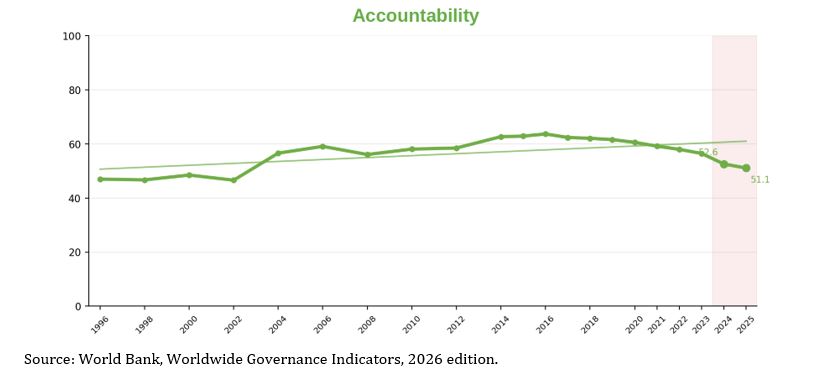
Accountability assesses citizens’ participation in governance, freedom of speech and the media, freedom of assembly and association, and opportunities for public oversight of government. Accordingly, this indicator most directly reflects the quality of the democratic environment.
Georgia’s score fell from 62.7 in 2014 to 59.2 in 2021, 56.5 in 2023, 52.6 in 2024, and 51.1 in 2025. Accordingly, the total loss in 2014–2025 was 11.5 points. The most recent phase is particularly severe: between 2023 and 2025, the country lost another 5.4 points.
The accelerated decline since 2024 coincides with a period in which civic and political space in Georgia was sharply restricted: pressure on independent media and civil society intensified, the environment for freedom of assembly and expression became more restrictive, and conditions for political competition deteriorated.
In its 2021 study, the Institute for Development of Freedom of Information had already pointed to deterioration in citizen participation and in freedoms of speech, the media, and assembly. The data now show that this problem not only persisted, but deepened sharply from 2024. The fall in the Accountability score to 51.1 confirms that the space for public oversight of government has become one of the weakest points of the past decade.
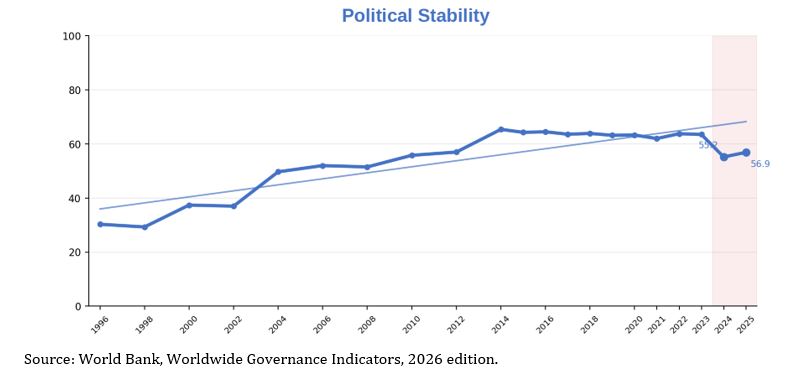
Political Stability assesses perceptions of the risks of violent changes of government, political violence, and terrorism. In Georgia’s case, the indicator is affected both by domestic political tensions and by Russia’s occupation of Georgian territories and the wider regional security environment.
Georgia’s score was 65.4 in 2014 and 63.5 in 2023. In 2024, it fell abruptly to 55.2 — a loss of approximately 8.3 points in a single year. In 2025, the score recovered slightly to 56.9, but it remained 8.5 points below the 2014 level.
The slight recovery in 2025 does not alter the assessment of the main trend. The sharp fall in 2024 coincided with acute political confrontation, mass protests, instances of violence and repressive responses, and intensified political polarisation.
The sharp deterioration of this indicator in 2024 reinforces the broader picture: the governance environment became more conflict-prone, unstable, and vulnerable to risks of violence.
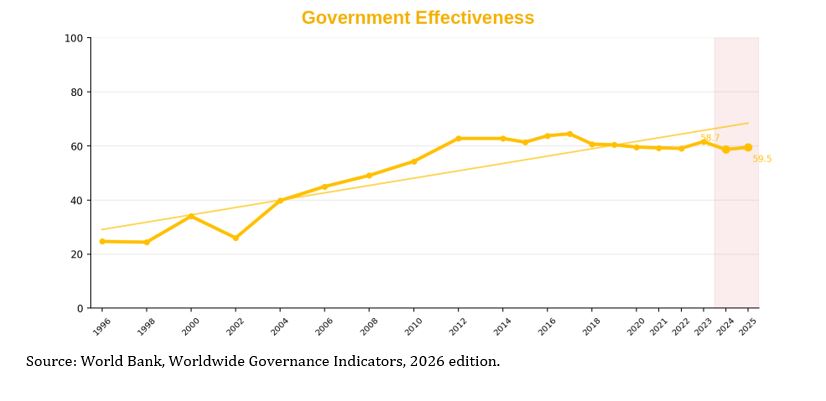
Government Effectiveness assesses the quality of public services, the professionalism and political independence of the civil service, the quality of policy formulation and implementation, and the government’s capacity to implement its decisions.
Georgia’s score was 62.8 in 2014, 61.6 in 2023, 58.7 in 2024, and 59.5 in 2025. The long-term decline is relatively small — 3.2 points — while 2025 recorded a partial 0.8-point recovery compared with 2024.
This relative resilience is not evidence of successful democratic governance. On the contrary, when read alongside the other indicators, it reveals a troubling imbalance: the state retains administrative and executive capacity while Accountability, Rule of Law, and Control of Corruption mechanisms are weakening.
From the standpoint of public oversight, this divergence is especially concerning. Strong executive capacity without an independent judiciary, free media, civic oversight, and effective anti-corruption supervision increases the risk of concentration of power. Effective administration cannot substitute for democratic accountability.
Regulatory Quality assesses the state’s ability to formulate and implement policies and regulations that support the functioning and development of the private sector.
This remains Georgia’s highest score among the six indicators: it stood at 70.8 in 2021, 70.1 in 2023, 67.4 in 2024, and 66.2 in 2025.
In IDFI’s 2021 study, Regulatory Quality was the area in which Georgia maintained a comparatively strong position relative to the preceding period. The new data show that even this exception is no longer on an upward trajectory: between 2021 and 2025, the score declined by 4.6 points.
Rule of Law assesses the effectiveness of the legal framework, the functioning of courts and law-enforcement institutions, protection of property rights, and the quality of law enforcement.
Georgia’s score fell from 64.6 in 2014 to 62.2 in 2021, 60.9 in 2023, 60.8 in 2024, and 60.2 in 2025. The total decline over 2014–2025 was 4.4 points. Annual changes may appear small, but over the decade the direction has been consistently negative.
This comparatively moderate decline does not mean that problems in the judiciary and legal institutions are moderate. The indicator combines many different components, and sharp deterioration in judicial independence may be partially offset in the overall score by property-rights protection, contract enforcement, or other administrative components.
Control of Corruption assesses both petty and high-level corruption, the use of public power for private interests, and risks of state capture by elite or private interests.
This is the most severe result in Georgia’s latest data. The score was 63.9 in 2014, 62.6 in 2021, 61.6 in 2023, 56.2 in 2024, and only 45.2 in 2025. Accordingly, the decline over 2014–2025 was 18.7 points, of which 11.0 points occurred in 2024–2025 alone.
While IDFI’s 2021 study identified the stalling of anti-corruption reforms and the risk of losing previous achievements as a problem, the 2025 data point to a qualitatively different challenge: Control of Corruption has fallen to the lowest level among all six indicators, and the steep downward trend accelerated precisely during the latest phase of democratic backsliding.
The significance of this indicator is particularly high because the World Bank’s assessment does not concern petty bribery alone. High-level corruption, political influence, conflicts of interest, and risks of state capture are integral parts of the indicator. A score of 45.2 is therefore not a technical fluctuation but a serious warning sign of concentration of power and weakening independent oversight.
The sharp decline in 2024–2025 coincides with a period in which international observers have increasingly criticised the mechanisms for controlling government power, the independence of anti-corruption institutions, and problems of accountability for high-level corruption.
The year 2024 deserves particular attention in Georgia’s Worldwide Governance Indicators trajectory. Compared with 2023, Accountability fell by approximately 3.9 points, Political Stability by 8.3 points, Government Effectiveness by 2.9 points, Regulatory Quality by 2.7 points, and Control of Corruption by 5.4 points. In 2025, the decline continued in Accountability, Regulatory Quality, Rule of Law, and, most notably, Control of Corruption.
This timing matters. The erosion that had been underway since 2014 entered a substantially sharper phase in 2024–2025. This period is associated with the strengthening of restrictive legislation targeting civil society, the expansion of practices restricting peaceful assembly and freedom of expression, instances of violence and administrative-criminal pressure against journalists and activists, reduced political competition, and the effective suspension of the EU integration process.
The World Bank indicators do not separately measure every specific cause of this process, but the overall trajectory is unequivocal: during the same period in which the condition of democratic institutions and freedoms deteriorated sharply, Georgia’s Accountability and Control of Corruption scores recorded their most severe declines. This convergence provides strong grounds for concluding that the governance crisis has become systemic.
IDFI’s 2021 study pointed to a significant slowdown in the pace of state development after 2014. Five years later, the World Bank’s updated data show that the problem has moved beyond that stage. In 2025, all six governance indicators stood below their 2014 levels, while the scale of backsliding in Control of Corruption and Accountability is substantial.
What is most alarming is where the backsliding is concentrated. The heaviest losses concern not the state’s capacity to function, but the control of public power: accountability, constraints on corruption, the rule of law, and the political environment. A state may retain administrative functionality and a certain level of regulatory quality, but this does not amount to democratic governance when the independent judiciary, media, civil society, and institutions that oversee power are simultaneously weakening.
The 2024–2025 data illustrate this dynamic particularly clearly. Several indicators deteriorated sharply at the same time in 2024, while in 2025 the Control of Corruption score collapsed to 45.2 and Accountability fell to 51.1. Accordingly, while in 2021 it was still possible to speak of a loss of reform momentum and stagnation, a more accurate assessment today is that Georgia’s governance system is undergoing systemic backsliding in democratic accountability and independent oversight, and cosmetic institutional changes are no longer sufficient to alter the current trajectory.
Alleged Sexual Violence against Giorgi Davitadze - Call for an Immediate and Effective Investigation
02.10.2026Solidarity with Vakho Sanaia
22.07.2026 Subscribe to Our News


